Holocaust Memorial Day Newcastle
Holocaust Memorial Day Newcastle
Holocaust Memorial Day takes place every year on 27 January, the anniversary of the liberation of Auschwitz by allied troops. It is a day to remember the millions of people murdered in the Holocaust and in the genocides that have followed. Each year Holocaust Memorial Day focuses on a theme that aims to help us learn more about the past, to empathise with others and to work towards a better future.
Newcastle has been an active and committed contributor to the National Holocaust Memorial Day programme since it began in 2000. The programme allows our city to not only commemorate and show respect for the victims of the Holocaust and other genocides but to engage with residents from all backgrounds to deliver a programme of creative and educational activities which:
- Identifies and examines discrimination and discriminatory behaviour and the consequences
- Encourages appropriate opposition
- Fosters better understanding of the origins and history of communities that have arrived in our city more recently
- Encourages greater tolerance and social inclusion; and
- Contributes to the council's ambitions around equality.
Newcastle's programme is recognised nationally and, in 2007, our city was the first in the UK, other than the national capitals, to host the National Commemorative Event. In 2015, the council decided to move from delivering the activities itself to offering funding for independent projects which provided a focal point for remembrance. The programme, which included lectures, exhibitions, films, plays, concerts work shops and learning activities, was a great success and created opportunities for more communities to take part in a way that not only reflected the diversity of Newcastle but made use of the wide range of skills, knowledge and commitment that is available in our city.
Our Holocaust Memorial Day activities have continued to be organised in this inclusive way ever since.
Holocaust Memorial Day learning project
As part of Newcastle's Holocaust Memorial Day 2026 schools in Newcastle took part in a new project developed by the Bosnian Genocide Educational Trust (BGET).
“I Am Because We Are” or 'I Am' is an immersive education project for schools in the UK. Students follow the personal stories of a genocide survivor from the Holocaust, Bosnia, Rwanda, Darfur or Cambodia. They also people based here in the UK who have helped to shape and share those stories including aid workers, teachers and others.
The programme is a survivor led, story centred programme grounded in human experience and reflective learning. Students have an opportunity to engage deeply with histories of genocide through personal stories, and to explore what this learning means for them, their schools and their wider communities. It is also an opportunity for students to reflect on their own stories, their identities, values, communities and experiences and to explore shaped the world we live in today.
The project embraces and embodies the Bridging Generations them by creating genuine intergenerational dialogue as students learn directly form survivors.
Bringing survivors, schools and communities together in Newcastle
In partnership with Smajo Bešo OBE of the Bosnian Genocide Education Trust, and with support from the Representative Council of North East Jewry, we adapted the 'We Are' project so the the majority of Newcastle’s secondary schools could take part.
Nearly 300 young people were able to participate in the programme and attend a Learning Day Conference in the Civic Centre on Monday 26 January 2026.
Our aim is to place the Holocaust at the centre of learning while also helping students to understand more about recent genocides and the dangers of failing to learn from the past.
About the Project
Throughout the academic year, young people from across Newcastle are engaging with the stories of genocide survivors through the 'I Am' project. Using personal testimonies, creative activities and reflective learning pupils were able to develop their understanding of:
- History and memory
- Empathy and identity
- The importance of standing up against prejudice and hate
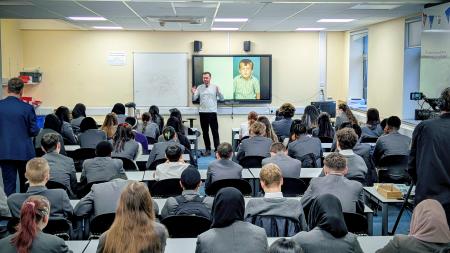
While the project explores multiple genocides, the Holocaust remains at its core in recognition of its unique place in world history,
Preparing for Holocaust Memorial Day
In the weeks leading up to Holocaust Memorial Day, schools across the city hosted visits from Holocaust survivor, Dr Martin Stern MBE, and Bosnian genocide survivor, Smajo Beso. These meetings helped prepare students for the Learning Day Conference hearing real human stories from those with lived experience.
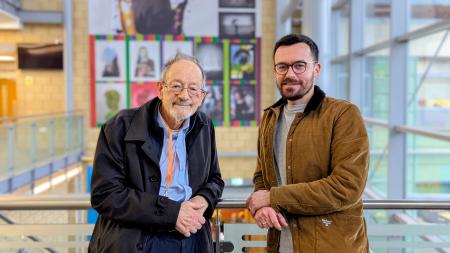
Martin's story
Martin Stern was born in 1938 in Hilversum, the Netherlands, to a German Jewish father and a non‑Jewish German mother. Their marriage was illegal under Nazi racial laws. The family fled to Holland, but when the Nazis occupied the country in 1940, Jewish people were rapidly stripped of their rights. Martin’s father, an architect, was banned from working and survived by secretly making wooden toys in their basement.
As persecution intensified, Martin’s father went into hiding. In 1942, when Martin’s mother went into labour, his father briefly returned to help her reach a hospital. Martin’s baby sister was born, but his mother died soon afterwards from an infection as there were no antibiotics. Martin never saw his father again.
After his mother’s death, Martin was taken in by a Dutch couple, Cathrien and Johannes Rademakers, who pretended he was their son. When Martin was five, two men in civilian clothes arrived unexpectedly at his small school and asked, “Is Martin Stern here?” His young teacher instantly understood the danger and replied, “No, he hasn’t come in today,” trying to shield him.
Martin, unaware of the risk, raised his hand and said, “But I am here.” As the men led him away, he looked back and saw his teacher’s face turn ashen, she knew what his arrest meant.
He was taken to an interrogation centre run by the Sicherheitsdienst (SD). As he was led through the corridor, he was deliberately walked past an open door where he recognised Johannes Rademakers. Calling out to him confirmed to the Nazis that the couple had sheltered a Jewish child—an act punishable in the same way as being Jewish. Johannes was later deported to Neuengamme concentration camp, where he died under brutal conditions
Martin’s baby sister had been taken in by another Dutch family who knew his grandparents. They bravely sheltered her for two years, but under threat from Dutch police collaborating with the Nazis, they were forced to hand her over.
Martin and his sister were reunited in Westerbork, a transit surrounded by barbed wire, watchtowers and armed guards. Martin, who was just five, was warned not to go near the fence or he would be shot. The camp was overcrowded and the food poor. Trains carrying people in cattle trucks left the camp every week. Martin saw ordinary railway workers load families into sealed wooden wagons, guarded by German soldiers who looked, to his young eyes, like normal men.
Martin and his sister were deported to Theresienstadt in Czechoslovakia. He arrived starving and alone. A Dutch prisoner, Mrs De Jong, who was imprisoned simply for marrying a Jewish man, rescued both children and cared for them in an adult dormitory at the camp. She stole food for them at enormous personal risk, kept them alive during typhus outbreaks and protected them as the camp became more overcrowded.
Theresienstadt was twice “beautified” for Red Cross inspections. The Nazis staged fake shops, orchestras, playgrounds and food displays to hide the reality of starvation and disease. After the first inspection, many prisoners involved in the deception were sent to Auschwitz and murdered.
Later, all the children in the camp were told they had to get on the next train. Mrs De Jong knew she couldn’t hide Martin and his sister. Even though she knew it meant certain death she decided to go with them. They went to the children’s dormitory but their names were never read out. Later, Mrs De Jong found out the train had already left.
The children on the train were taken to Auschwitz and later gassed. No one knows why martin and his sister were not called, an administrative oversite or possibly sheer luck.
The Nazis attempted to build a gas chamber in Theresienstadt but the Soviets were approaching and Germany was collapsing before it could be finished. The Red Cross took over before the Germans could destroy the camp. On the night of 8 May 1945 the Soviets liberated the camp.
After liberation, Martin, his sister and Mrs De Jong took a long, dangerous journey back to the Netherlands. One night his sister fell from a moving lorry but survived with only scratches. Devastatingly, when they finally arrived in the Netherlands the children were taken away from Mrs De Jong.
The family who had previously cared for his sister reclaimed her. Martin spent the next years moving between families and schools until the family who cared for his sister eventually took him in. Unfortunately, the woman of the family didn’t really want him and he was treated unkindly.
In 1950, both children went to live with relatives of his father in Manchester who wanted to look after them. Martin could not speak any English when he arrived but soon learned. After arriving in the UK as a refugee, Martin became a British citizen at the age of 16. He became a doctor, got married and raised three children. Later, despite many years apart, he reunited with Mrs De Jong.
Martin always expresses gratitude to Britain for giving him a home and a future. Today he dedicates his life to Holocaust education, speaking to young people about prejudice, bystander behaviour and the escalation of hatred.
Smajo's story
Smajo Bešo has witnessed both the darkest and brightest sides of humanity. A survivor of the Bosnian genocide, he eventually found safety in the United Kingdom, where he now proudly embraces both his Bosnian heritage and his adopted Geordie identity.
Born on 29 March 1985 in the small southern town of Stolac, Smajo enjoyed a joyful and carefree childhood. His parents, still in their thirties, had designed and built the family home themselves. Life revolved around cartoons, books and football—simple pleasures that defined his early years.
Bosnia was a diverse and welcoming place. Smajo grew up in a Muslim family but never saw himself as different from his Serb and Croat neighbours. Christmas was spent at the home of his Catholic friends, and during Eid, those same neighbours brought gifts to his family. But by the early 1990s, political rhetoric had turned poisonous. Bosnian Muslims were increasingly dehumanised, compared to disease and vermin. As a child, Smajo sensed the shift, even if he didn’t yet understand it.
When Smajo was seven, the siege of Sarajevo began, marking the start of Europe’s only genocide since the Holocaust. In spring 1992, war reached his village. Although the soldiers surrounding them wore the uniform of the Yugoslav army, they were in reality Serb forces under the control of Slobodan Milošević.
At first, the situation felt surreal. Soldiers—many of them familiar faces—would drop in for coffee. But the atmosphere quickly darkened. One day, a soldier who had visited daily suddenly turned on the family, hurling abuse and sharpening a knife while declaring it “a good day to slit throats.” Only the intervention of another Serb friend saved them.
Within months, the family fled their home. In the first nine months of war, they moved 14 times before finding temporary refuge with an uncle.
Smajo’s father, Džemal, joined army alongside his Croatian neighbours. But a year into the conflict, Bosnian Croats turned on their Bosniak Muslim allies. In summer 1993, Croatian forces began rounding up Muslim men and boys, including Smajo’s father and many relatives, some as young as sixteen. That night, Smajo cried himself to sleep and afterwards refused to leave his mother’s side.
In August 1993, soldiers arrived in the village threatening rape and murder. On 4 August, the family was rounded up and taken to a “collection centre,” where they were interrogated and searched. Smajo’s mother was forced to sign away all their possessions before they were loaded onto cattle trucks and transported toward Bosnian government territory. Along the roadside, Smajo saw abandoned belongings with the body of an elderly man lying among them.
The family eventually reached Mostar, where they stayed with Smajo’s Aunt Emina. The city was trapped between Serbian forces on one side and Croatian forces on the other. Conditions were horrific: constant shelling, hunger, and fear. His mother and aunt showed remarkable resilience, baking bread from chicken feed and making pies from grass.
Determined to learn to read and write—especially as letters from his father began arriving through the International Red Cross—Smajo and his siblings started school as an act of defiance though they attended at night for safety.
Through those letters, they learned the truth about their father’s imprisonment. He had been held in a former military complex deep inside a mountain, starved and abused. Within weeks, he had lost four stone. He still cannot speak fully about what his experience.
After several months, the International Committee of the Red Cross secured the release of around 500 prisoners. The UK was among the countries that offered refuge, and Džemal was brought to Newcastle. It would be six long months before the family could join him.
On 24 January 1994, the final day of school, Croatian forces bombed Mostar. From his classroom window, Smajo watched his neighbourhood erupt in flames. When he reached home, he discovered that Aunt Emina had been fatally wounded by shrapnel. She died in a makeshift medical facility. Her death devastated him. In his grief and anger, his mother sat him down and urged him not to let hatred take root, a lesson he carries with him to this day.
On 19 June 1994, the family was told they had two hours to pack. They were being evacuated to the UK to reunite with Džemal. After a month in a Croatian refugee camp, they travelled to Newcastle. Smajo was nine years old when he saw his father again for the first time in over a year.
Their plan had always been to return home, but they later learned their house had been torched. They still keep the key, holding onto the hope that one day they might go back.
Smajo’s father had come to the UK on 19 January 1994; the rest of the family left Bosnia on 19 June 1994 and arrived in Newcastle on 19 July that same year. Smajo calls 19 their lucky number.
In 2020, Smajo founded the Bosnian Genocide Educational Trust, dedicated to raising awareness and ensuring the lessons of the genocide are never forgotten.
In 2023, he was awarded an OBE for his services to genocide education and commemoration.
Leaving behind home, culture, friends, and neighbours is never a choice made lightly. For years, Smajo longed to return to Bosnia. But the people of Newcastle welcomed his family with warmth, helping them rebuild their lives.
Today, Smajo proudly identifies as both Bosnian and Geordie. A testament to resilience, community and the enduring strength of the human spirit.
Learning Day Conference
Three hundred students and their teachers gathered for a day of learning, reflection and dialogue. The programme included:
- Opening reflections
- Student led sessions based on learning inspired by survivor testimony
- Small group discussions with members of the Jewish community
- Opportunities for students to ask questions, deepen understanding and build empathy
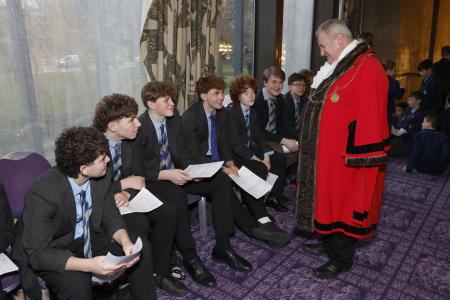
The conference encouraged mutual recognition, intergenerational conversations and an enhanced appreciation of the human impact of genocide.
Holocaust Memorial Day Commemorative event
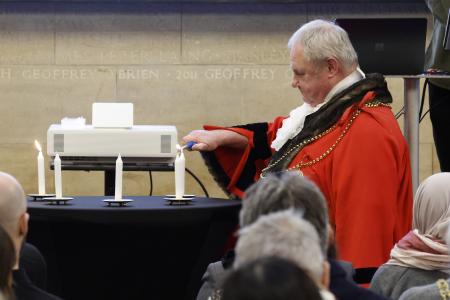
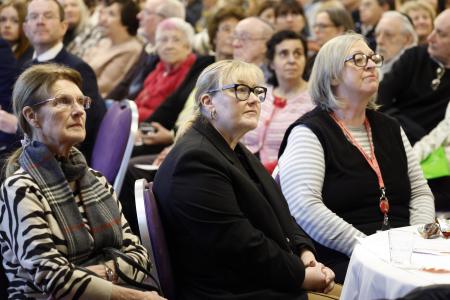
At the end of the conference, the wider community came together for Newcastle's Holocaust Memorial Day Commemorative event.
After lighting the memorial candle, the programme featured:
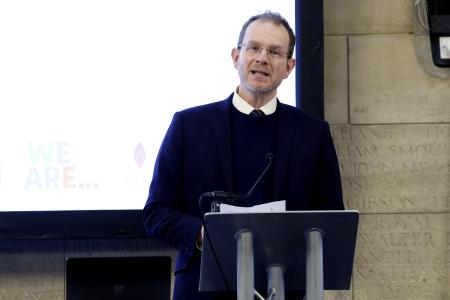
- Guest speakers including Smajo Beso OBE and Dr Martin Stern MBE
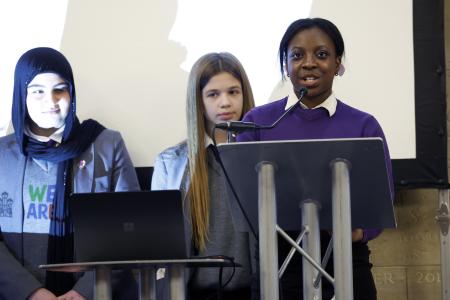
- Students reflecting on what they have learned
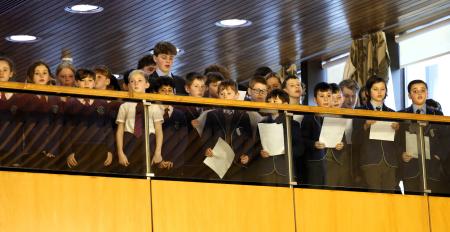
- A choir performance of a specially written song, Bridging Generations, celebrating hope and unity
The event brought together people of all ages and backgrounds in remembrance, solidarity and shared responsibility.
Continuing the Learning Journey
The project does not end on Holocaust Memorial Day. During the remainder of the year, students will continue exploring the histories and testimonies of more recent genocides. This ongoing work strengthens their understanding of identity, community and the urgent need to challenge prejudice and discrimination wherever it appears.
Did you know?
10,000 unaccompanied children in Nazi territories between the ages of 5 and 16 were given refuge in the UK. This was a unique humanitarian operation which became known as the Kindertransport.
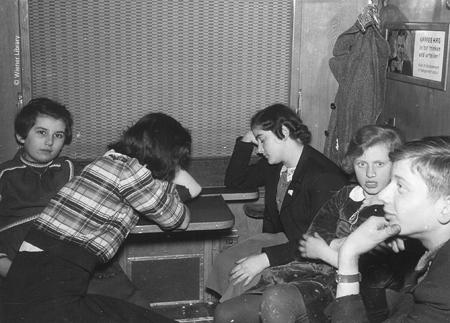
Read more about at Kindertransport and refugees.
If you would like to give us feedback on our website, please complete this short online form.